Overview
Contoura Vision is frequently described as the most advanced specs removal surgery available today. Hospitals that offer it lead with that positioning, and most people researching specs removal in Ghaziabad encounter Contoura Vision early in their search.
The honest question to ask before booking is whether it is actually the right procedure for every person who wants to get rid of their glasses. The answer is no, and understanding why helps someone make a genuinely informed decision rather than simply booking the most premium-sounding option.
At Manav Hospital in Ghaziabad, Contoura Vision is performed by Dr Rajat Gupta, an ophthalmologist with specific expertise in refractive surgery. Patient reviews consistently mention his thoroughness in explaining the procedure before doing anything. That approach to pre-operative communication is exactly what helps patients understand whether Contoura Vision is right for them specifically.
What Is Contoura Vision and What Makes It Different?
Contoura Vision is a form of topography-guided LASIK. The distinction from standard LASIK is in how the laser treatment is planned and delivered.
Standard LASIK uses your spectacle prescription to guide the laser. It corrects the sphere and cylinder values, the numbers on your glasses prescription, by reshaping the cornea to the optimal curvature for your prescription. This produces excellent results for most patients.
Contoura Vision adds a layer to this. Before surgery, 22,000 data points on your corneal surface are mapped using topography technology. This creates a detailed picture of the unique irregularities in your specific cornea that exist beyond the basic prescription. The laser treatment is then guided by this map, correcting both the prescription and those surface irregularities simultaneously.
The practical benefit is better quality of vision, particularly in low-light conditions. Patients who had standard LASIK and experienced glare, halos around lights, or reduced contrast sensitivity in dim environments often find that Contoura Vision patients report fewer of these symptoms. The reason is that the treatment addresses more of the optical system than prescription correction alone.
Who Actually Benefits Most From Contoura Vision?
The full ophthalmology department at Manav Hospital also manages broader eye health concerns alongside refractive surgery, so any other vision issues can be reviewed at the same visit.
This is a more useful question than whether Contoura Vision is simply better than LASIK, which is a matter of degree rather than a categorical difference.
Patients who benefit most from Contoura Vision over standard LASIK are those who:
• Place particular importance on visual quality in low-light conditions, night driving, and working with screens in variable lighting
• Have corneal irregularities beyond their basic prescription that standard LASIK would not address
• Are in professions where visual acuity in all conditions matters significantly
• Have had detailed discussions about their visual priorities and want the most complete optical correction available
Standard LASIK produces excellent outcomes for most patients and is appropriate for people who want effective specs removal without the additional cost that Contoura Vision carries.
Who Is Not Suitable for Contoura Vision or Any LASIK Procedure?
This is as important as knowing who benefits most. Not everyone who wants specs removed is a suitable candidate for corneal laser surgery, Contoura Vision, or otherwise.
Key factors that affect suitability:
Corneal thickness. Both LASIK and Contoura Vision require a minimum corneal thickness for safe treatment. The laser removes a very thin layer of corneal tissue, and if the cornea is too thin to begin with, the procedure cannot be done safely. This is assessed with imaging before any recommendation is made.
Prescription stability. Laser vision correction works by reshaping the cornea to your current prescription. If your prescription has been changing significantly from year to year, the result will not be stable. Most surgeons require at least one to two years of stable prescription before recommending any laser procedure.
Dry eye. LASIK procedures can worsen dry eye in people who already have it. A tear film assessment before surgery identifies patients where this is a significant risk.
Keratoconus or corneal disease. Any condition affecting the structural integrity of the cornea is a contraindication for LASIK or Contoura Vision. Patients with keratoconus require a different approach. Cornea and keratoconus treatment at Manav Hospital covers this separately for patients where standard laser surgery is not appropriate.
Very high prescriptions. Extremely high myopia or hyperopia may not be fully correctable with laser surgery. There are limits to how much corneal tissue can be safely removed.
What Happens If You Are Not Suitable for Contoura Vision or LASIK?
This is where having access to a full ophthalmology department rather than a standalone refractive centre matters. Patients who are not suitable for laser surgery are not simply turned away. There are alternatives.
ICL lens surgery implants a lens inside the eye rather than removing corneal tissue. It is particularly suited for patients with high prescriptions or thin corneas who are not candidates for LASIK. ICL lens surgery at Manav Hospital is available for patients in this category and produces excellent results, sometimes better than what laser surgery could achieve for the same prescription.
Standard LASIK remains an appropriate option for many patients who want effective specs removal without the additional cost of Contoura Vision, and where the advanced topographic mapping does not add meaningful benefit for their specific prescription and corneal profile.
The pre-operative assessment at Manav Hospital determines which of these options is genuinely most appropriate for each patient before any decision is made.
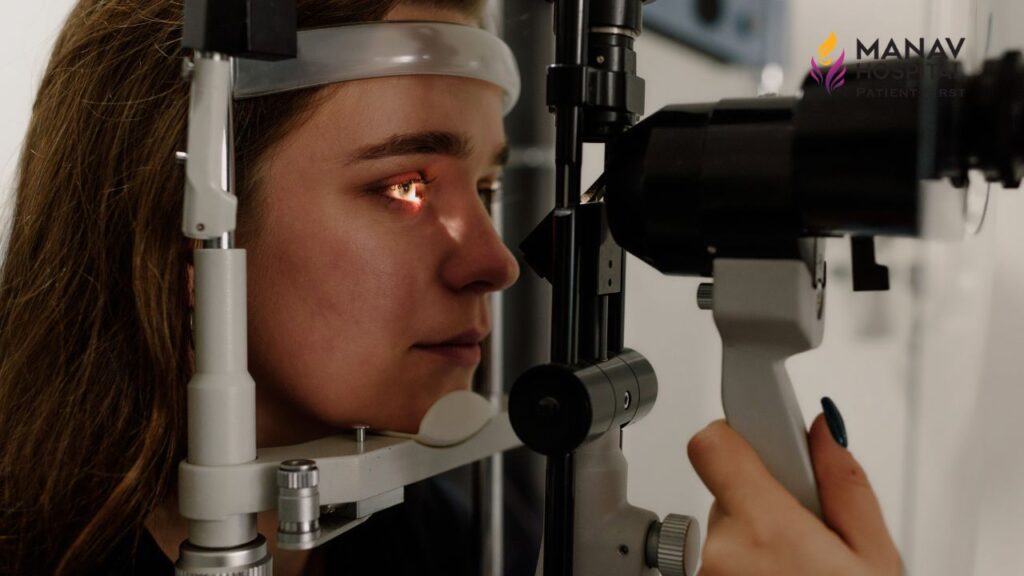
What Does the Pre-Operative Assessment for Contoura Vision Involve?
A thorough pre-operative assessment is what makes the difference between a well-planned outcome and a procedure performed without adequate information. At Manav Hospital, this includes:
• Corneal topography to map the surface in detail
• Corneal pachymetry to measure thickness
• Wavefront analysis to assess higher-order aberrations
• Pupil size measurement in different light conditions
• Tear film assessment for dry eye evaluation
• Cycloplegic refraction for an accurate prescription without accommodation influencing the result
• General ocular health examination
Dr Rajat Gupta reviews all of this data before confirming whether Contoura Vision is appropriate and what the realistic outcome will be. Patient reviews consistently mention that he explains findings clearly and addresses questions without rushing, which is particularly important for a procedure that involves permanently reshaping the eye.
You can also explore standard LASIK laser surgery at Manav Hospital and compare it with Contoura Vision at the consultation to make an informed decision about which option fits your priorities and budget.
Conclusion
Contoura Vision is a genuinely more advanced form of specs removal than standard LASIK for patients where the additional corneal mapping adds meaningful benefit to visual quality. It is not, however, automatically the right choice for every person who wants specs removed. The right procedure depends on the individual corneal profile, prescription, lifestyle priorities, and what the pre-operative assessment actually shows. A thorough consultation at Manav Hospital with Dr Rajat Gupta is what determines that honesty, rather than defaulting to the most premium option, regardless of whether it adds value for a specific patient.
Frequently Asked Questions
Q. Is Contoura Vision permanent in Ghaziabad?
The corneal reshaping from Contoura Vision is permanent. Vision remains stable for most patients long-term. Age-related changes like presbyopia develop independently, as they would in anyone who has not had laser surgery.
Q. How long does Contoura Vision recovery take at Manav Hospital?
Most patients notice significantly improved vision within 24 to 48 hours. Full stabilisation of vision takes 2 to 4 weeks. Activity restrictions are minimal, and most people return to their normal routine within a day or two.
Q. What is the cost difference between Contoura Vision and standard LASIK in Ghaziabad?
Contoura Vision costs more than standard LASIK, reflecting the additional topographic mapping and treatment planning involved. Current pricing is available directly from Manav Hospital. The difference should be weighed against whether the visual quality benefit of Contoura Vision applies to your specific situation.
Q. Can I get Contoura Vision if I have astigmatism?
Yes. Contoura Vision addresses both myopia and astigmatism. The topographic mapping actually provides a more precise correction of astigmatism than standard LASIK in many cases because it addresses the corneal surface irregularities that contribute to astigmatism rather than just the prescription component.
CTA