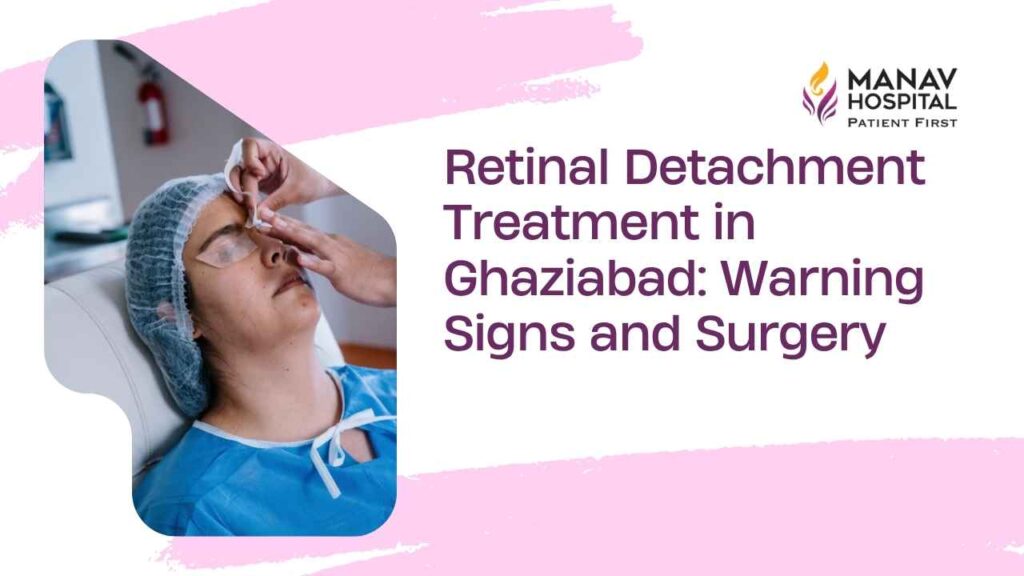
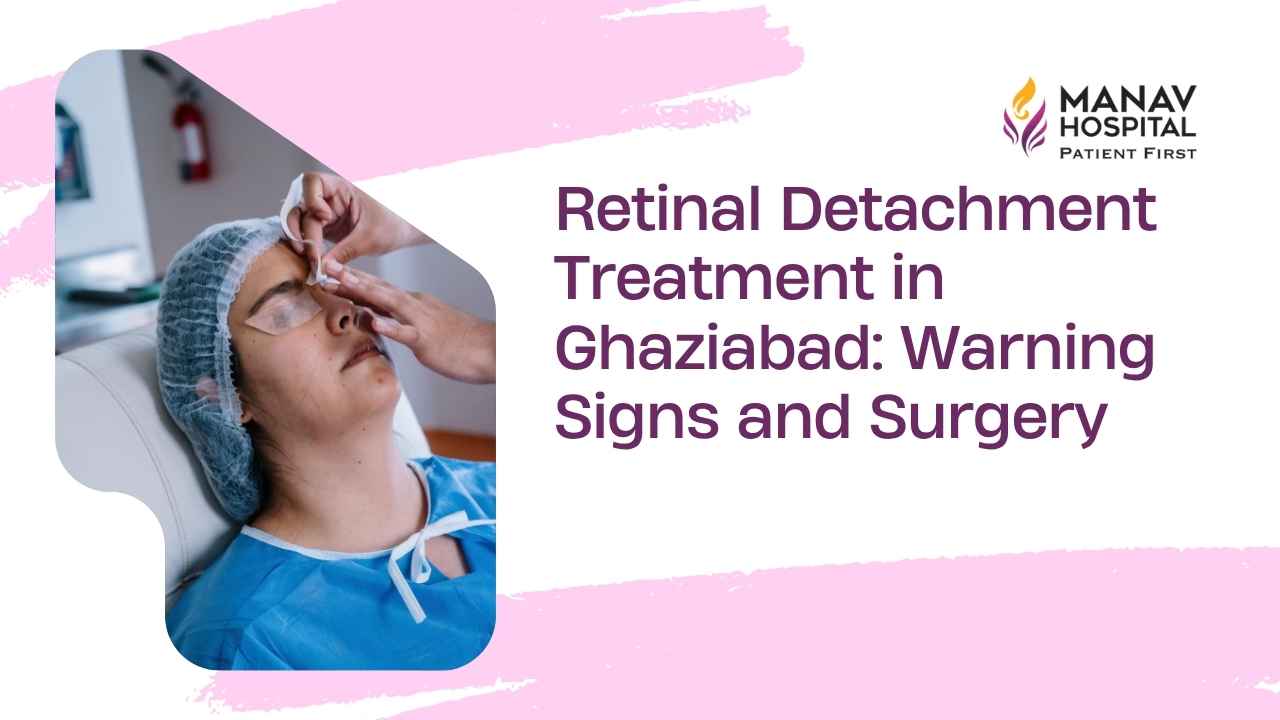
Sudden new floaters, flashes of light or a dark curtain across your vision can mean the retina is pulling away from the back of the eye, and this needs an eye examination the same day. Retinal detachment is usually painless, which is why people wait, but the sooner the retina is reattached, the better the chance of saving vision. Depending on the tear, treatment may be laser, freezing, a gas bubble, a scleral buckle or vitrectomy surgery.
Overview
Most people ignore a few floaters. That is fair, because floaters are common and often harmless. The trouble starts when they arrive suddenly, in showers, or together with flashes or a shadow at the edge of your vision. If that is happening to you, please do not wait for the weekend. Book a retina consultation at Manav Hospital and get your eye examined with the pupil dilated, because that is the only way to see the whole retina.
At Manav Hospital in Kavi Nagar, our retinal detachment treatment in Ghaziabad covers everything from a small tear that needs a laser to a detachment that needs surgery. Our eye department has looked after patients in the city since 1980, so many families here already know us. You can also read about our approach to retina treatment in Ghaziabad, or watch short explainers on our YouTube channel. This guide explains the warning signs, how the diagnosis is made and what each treatment actually involves.
What Does a Retinal Detachment Feel Like?
The classic retinal detachment symptoms
● A sudden shower of new floaters, like specks, threads or cobwebs
● Flashes of light, often in the corner of your vision, more noticeable in the dark
● A grey shadow or curtain moving across one side of your sight
● Blurred vision that appears quickly in one eye
There is usually no pain, so a painless change in vision should never be brushed off as nothing.
Are Flashes and Floaters in the Eye an Emergency?
When to worry and when to relax
Old, familiar floaters that have been there for years are rarely a concern. New ones are different. When the gel inside the eye (the vitreous) shrinks and tugs on the retina, it can cause flashes and a sudden crop of floaters. Often nothing tears. Sometimes it does, and a tear can become a detachment within days.
● Floaters that are new, many in number or increasing: get checked within a day
● Flashes that keep coming back: get checked within a day
● A curtain or shadow in your vision: treat it as an emergency
You cannot tell a harmless floater from a retinal tear by looking in the mirror, so a dilated examination is the safe answer.
What Is the Difference Between a Retinal Tear and a Retinal Detachment?
A tear is a break in the retina. A detachment happens when fluid passes through that break and lifts the retina away from the wall of the eye. A tear caught early can be sealed in a short sitting with laser. A detachment needs more involved treatment. That gap is the whole reason doctors insist on quick checks for flashes and floaters.
Meet Dr. Rajat Gupta, Ophthalmologist at Manav Hospital
Dr. Rajat Gupta is the ophthalmologist who often sees patients first when they walk in with sudden vision changes. He completed his MBBS in 2006 and MS in Ophthalmology in 2010, followed by fellowship training in cornea, LASIK and refractive surgery, and DALK/DSEK surgery. For retina cases, the department works as a team, with a vitreoretinal surgeon, Dr. Anshu Arora, handling detachment surgery when it is needed.
Professional Highlights
● MBBS and MS Ophthalmology
● Fellowships in cornea, refractive surgery and DALK/DSEK
● Over 40,000 topical micro-incision cataract procedures
● Selected by Bausch and Lomb to teach other doctors about cataract procedures
You can see his clinical updates on Instagram or call +91-9718942666 | info.manavhospital@gmail.com to book.
Who Is More Likely to Get a Retinal Detachment?
Risk factors worth knowing
● High myopia (very strong minus power spectacles)
● A previous cataract operation
● A past eye injury or a blow to the eye
● A family history of retinal detachment
● A detachment or a tear in the other eye
● Diabetes with retinal changes
If you are in one of these groups, a yearly dilated retina check is a sensible habit. People with a strong glasses power often come to us only when something goes wrong, and a screening visit is far easier than an emergency. If you are thinking about vision correction, read our guide on how to choose the right LASIK surgeon in Ghaziabad, because a healthy retina check is part of any good refractive assessment. People who have had cataract surgery should also read what happens after cataract surgery so they know which new symptoms to report.
How Is a Retinal Detachment Diagnosed?
What happens during the examination
● Your vision and eye pressure are checked
● Drops widen the pupil for a clear view of the whole retina
● The doctor examines the retina with a special lens and bright light
● An ultrasound scan is used if the view is blocked, for example by bleeding inside the eye
● Scans of the macula may be done to see whether the central retina is affected
The dilated examination takes some time and your near vision will be blurry for a few hours, so please bring someone with you.
What Are the Treatment Options for Retina Surgery in Ghaziabad?
The right treatment depends on whether the retina has only a tear, or has already lifted. The surgeon decides after examining the eye, not before.
1. Laser or Freezing Treatment for Tears
A small tear that has not yet lifted the retina can often be sealed with laser or cryotherapy. It is done in a short sitting, and it works by creating a scar around the tear so the fluid cannot get under it. Early treatment here can prevent a detachment altogether.
2. Pneumatic Retinopexy
For selected detachments, a gas bubble is placed inside the eye so it presses the retina back against the wall. The tear is then sealed with laser or freezing. You need to hold your head in a particular position for some days so the bubble stays in the right spot.
3. Scleral Buckling
A soft silicone band is stitched to the outside wall of the eye, gently pushing the wall towards the detached retina. This is often chosen for younger patients and for certain types of detachment.
4. Vitrectomy
The vitreous gel that is pulling on the retina is removed, the retina is flattened, and the tears are sealed. Gas or silicone oil is then placed in the eye to hold the retina in place while it heals. Complex detachments are often managed this way.
For a deeper look at our retina service, visit our retina surgery page or explore the wider ophthalmology department.
Why Choose Manav Hospital for Retina Care?
Key advantages
● A full eye department under one roof, from refraction to surgery
● Dilated retina examination and scanning in the same visit
● A team approach, with an ophthalmologist and a vitreoretinal surgeon
● Eye care experience in Ghaziabad since 1980
● Clear explanation of the options before any procedure is booked
Follow our Instagram page for eye health reminders that help you spot trouble early.
Signs You Should Not Wait for Your Retina Appointment
● A curtain or shadow that is growing
● Sudden loss of central vision
● Straight lines looking wavy or bent
● A new floater after an eye injury
● Flashes after cataract surgery
If any of these are happening, come in the same day.

What Is the Treatment Journey Like at Manav Hospital?
- Call or book online: Tell us your symptoms so we can prioritise urgent cases.
- Dilated examination: Your retina is examined fully, with scans if needed.
- Diagnosis and options: The doctor explains whether you have a tear, a detachment or a harmless change.
- Treatment: A laser sitting, a gas bubble or surgery, depending on the findings.
- Follow-up: Checks at planned intervals to make sure the retina stays attached.
What Are the Benefits of Acting Early?
✔ A higher chance of keeping central vision
✔ Simpler treatment, often laser instead of surgery
✔ Less risk of scar tissue forming on the retina
✔ A shorter recovery
✔ Peace of mind, even when the result turns out to be harmless
What Is Recovery Like After Retina Surgery?
Recovery varies with the procedure. After laser, most people go about their day normally. After a gas bubble or vitrectomy, you may be asked to hold a head position for several days, avoid flying and avoid lifting heavy things until the surgeon says it is safe. Vision can be blurry for a while and improves slowly. Our YouTube channel has patient education videos you can revisit during recovery.
Care after treatment
● Use eye drops exactly as prescribed
● Keep the follow-up visits, even if the eye feels fine
● Do not rub the eye
● Avoid travel by air or to high altitude while a gas bubble is in the eye
● Report any new shadow, pain or redness at once
Good vision after surgery depends as much on following the instructions as on the operation itself.
Why Do Ghaziabad Patients Trust Manav Hospital?
● Over four decades of eye care in the city
● Easy access in Kavi Nagar, with doctors you can reach through our contact page
● Honest advice on whether surgery is needed at all
● Doctors who explain, not just prescribe
● One hospital for eye, bone and dental care for the whole family, with regular updates on Instagram and YouTube
Conclusion
A retinal detachment is serious, but it is treatable, especially when caught quickly. If you have noticed new floaters, flashes or a shadow in your vision, do not wait for it to settle. A dilated examination can tell you within an hour whether your retina is safe. The team at Manav Hospital is ready to see you, explain what is happening in plain language and treat it properly if needed.
Contact Manav Hospital
Email: info.manavhospital@gmail.com
Phone: +91-9718942666
Follow us on Instagram and YouTube
Book your retina consultation with Manav Hospital here
FAQs
Can a retinal detachment heal on its own?
No. A detached retina does not reattach by itself, and it needs treatment. Waiting can cause permanent loss of vision in the affected area.
Is retinal detachment surgery painful?
The procedure is done with anaesthesia, so you should not feel pain during it. Some discomfort and scratchiness afterwards is usual and is eased with the prescribed drops and medicines.
How soon should I see a doctor after I notice flashes and floaters?
Within a day if they are new. If you see a curtain or shadow, go the same day. You can call +91-9718942666 to ask for an urgent slot.
Will I get my full vision back after retina surgery?
It depends on how long the retina was detached and whether the central part (macula) was involved. Early treatment gives the best outcome, and your surgeon can tell you what to expect for your eye.
Can wearing strong glasses lead to retinal detachment?
The glasses do not cause it, but high myopia makes the retina thinner and more fragile. People with a high minus power should have regular dilated retina checks. See more eye care tips on our Instagram.