Overview
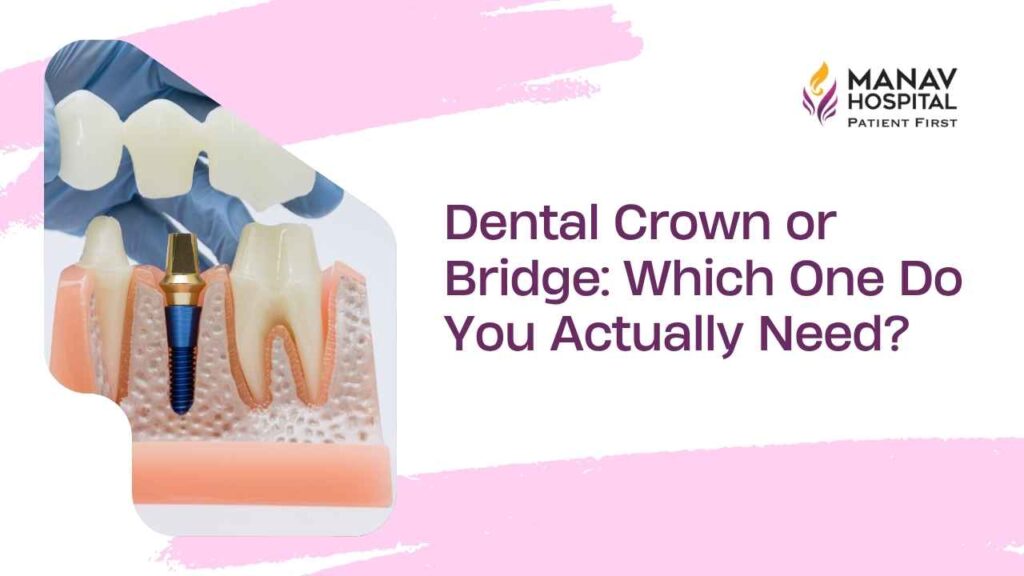
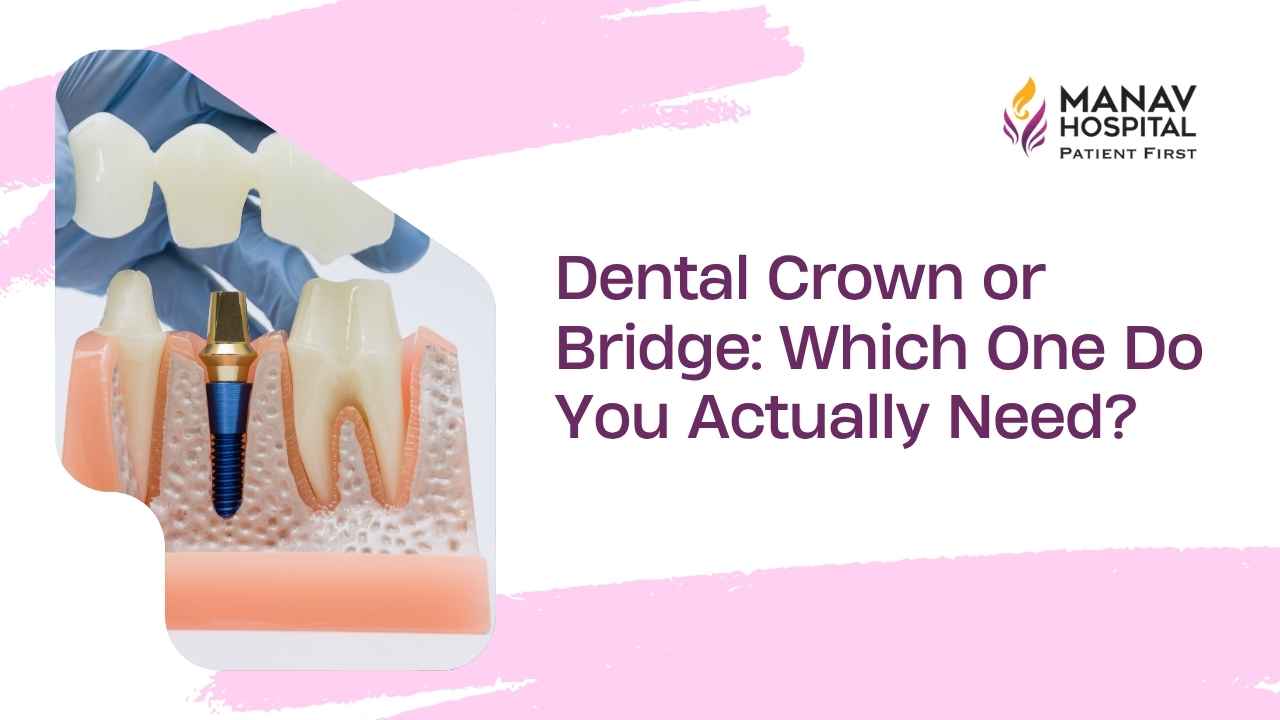
Patients often use “crown” and “bridge” almost interchangeably, assuming they’re two names for a similar procedure. They’re not. The distinction is actually simple once explained clearly: a crown restores a tooth that’s still there, while a bridge replaces a tooth that’s already gone. Understanding Crowns and Bridges in Ghaziabad properly means knowing which situation you’re actually in before assuming either treatment applies.
At Manav Hospital’s dental department, Dr. Kanika Gupta evaluates each case individually, since the right choice depends on tooth condition, the number of missing teeth, and overall oral health, not personal preference alone.
The Simple Rule That Actually Decides It
The core distinction:
● A crown covers and protects a single damaged, weakened, or heavily restored tooth that’s still present
● A bridge replaces one or more missing teeth by anchoring artificial teeth to nearby natural teeth or implants
● If the tooth can be preserved, a crown is typically recommended
● If the tooth is already missing or cannot be saved, a bridge fills that specific gap
A crown restores a tooth that is still there. A bridge replaces a tooth that is missing. That single distinction resolves most of the confusion between the two.
Meet Dr. Kanika Gupta – Crowns and Bridges Specialist in Ghaziabad
Patients unsure whether they need a crown or a bridge want a dentist who evaluates their specific tooth condition, not one recommending the more expensive option by default.
Professional Highlights:
● Dental Surgeon at Manav Hospital, Ghaziabad
● Master’s degree in dental surgery with a restorative specialisation
● Experience managing both crown and bridge restorations
● Life member of the Indian Society of Oral Implantologists (ISOI)
Patients can describe their specific dental concern directly via WhatsApp before booking a consultation.
How the Decision Is Actually Made
1. Condition of the Tooth Itself
A cracked, heavily decayed, or post-root-canal tooth that’s still structurally present generally needs a crown.
2. Whether the Tooth Is Missing
A gap left by a missing tooth needs a bridge to restore both function and appearance.
3. Health of Neighbouring Teeth
For traditional bridges, adjacent teeth need to be strong enough to support the restoration.
4. Long-Term Oral Health Goals
Both restorations typically last 10 to 15 years or longer with proper care, making long-term planning worthwhile.
Why Choose Manav Hospital for Crowns and Bridges?
Key advantages:
● Individual evaluation determining which restoration your specific case actually needs
● Access to both crown and bridge treatment under one dental team
● Material options discussed transparently based on your needs and budget
● Continuity of care for any related dental work
A dentist who explains why a crown or bridge is right for your specific tooth, not just recommends one by default, is what actually builds trust in the treatment plan.
Signs You Might Need a Crown or Bridge
Consider a consultation if:
● You have a cracked, heavily decayed, or root-canal-treated tooth that’s still present
● You’re missing one or more teeth affecting how you chew or speak
● Neighbouring teeth have started shifting into a gap left by a missing tooth
● A previous filling has weakened significantly and needs stronger protection
A gap left unaddressed for too long allows neighbouring teeth to shift, which is exactly why timely treatment matters for either restoration.
Step-by-Step Crown or Bridge Treatment Journey
1. Initial Consultation and Assessment
Your specific tooth condition is evaluated to determine whether a crown or bridge is appropriate.
2. Tooth Preparation
The affected tooth, or adjacent teeth for a bridge, is prepared and reshaped as needed.
3. Impressions and Temporary Restoration
Impressions are taken, with a temporary restoration placed while the permanent piece is custom-made.
4. Permanent Placement
The final crown or bridge is fitted, adjusted, and cemented into place.
5. Follow-Up Check
A follow-up visit confirms fit, comfort, and bite alignment.
Benefits of Choosing the Right Restoration
✔ Preserves a damaged tooth when a crown is genuinely the right fit
✔ Restores chewing function and prevents teeth from shifting with a bridge
✔ Both restorations typically last 10 to 15 years or longer with proper care
✔ Matched specifically to your tooth condition, not a generic recommendation
✔ Improves both function and natural appearance of your smile
Choosing the restoration that actually matches your tooth condition, rather than assuming one option fits every case, is what protects your smile long-term.
What to Expect After Treatment
Aftercare typically includes:
● Avoiding very hard or sticky foods immediately after placement
● Maintaining consistent brushing and flossing, including under a bridge with a floss threader
● Attending regular check-ups to monitor the restoration’s condition
● Reporting any discomfort or looseness promptly
Proper care after placement is what helps a crown or bridge genuinely reach its full 10 to 15 year lifespan.
Why Ghaziabad Patients Choose Manav Hospital for Crowns and Bridges
● Individual evaluation before recommending either restoration
● Experience managing both crown and bridge cases
● Transparent guidance on material options and costs
● Direct WhatsApp access at wa.me/919718942666 for questions
● Continuity of dental care under one experienced team
Patients who understand exactly why a crown or bridge was recommended for their specific case consistently feel more confident committing to treatment.
Conclusion
The crown-versus-bridge decision comes down to one simple question: is the tooth still there, or is it missing? Dr. Kanika Gupta and the dental team at Manav Hospital evaluate each case individually to determine which restoration genuinely fits your situation.
For questions about crowns or bridges, email info.manavhospital@gmail.com or call +91-9718942666. Follow dental care updates on Instagram and YouTube.
Book your dental consultation with Manav Hospital here.
FAQs
How do I know if I need a crown or a bridge?
If your tooth is still present but damaged or weakened, you likely need a crown. If the tooth is missing entirely, a bridge fills that specific gap.
Do crowns and bridges last the same amount of time?
Yes, both typically last 10 to 15 years or longer with proper oral hygiene and regular dental check-ups.
Does getting a bridge require altering healthy teeth?
For a traditional bridge, yes, the adjacent teeth are reshaped to support the restoration, unless the bridge is implant-supported instead.
Is getting a crown or bridge painful?
The procedure is performed under local anaesthesia, so patients typically feel pressure rather than pain. Mild soreness afterward is normal and temporary.
Can a bridge be used if my neighbouring teeth aren’t very strong?
If adjacent teeth are weakened, an implant-supported bridge or alternative restoration may be recommended instead of a traditional tooth-supported bridge