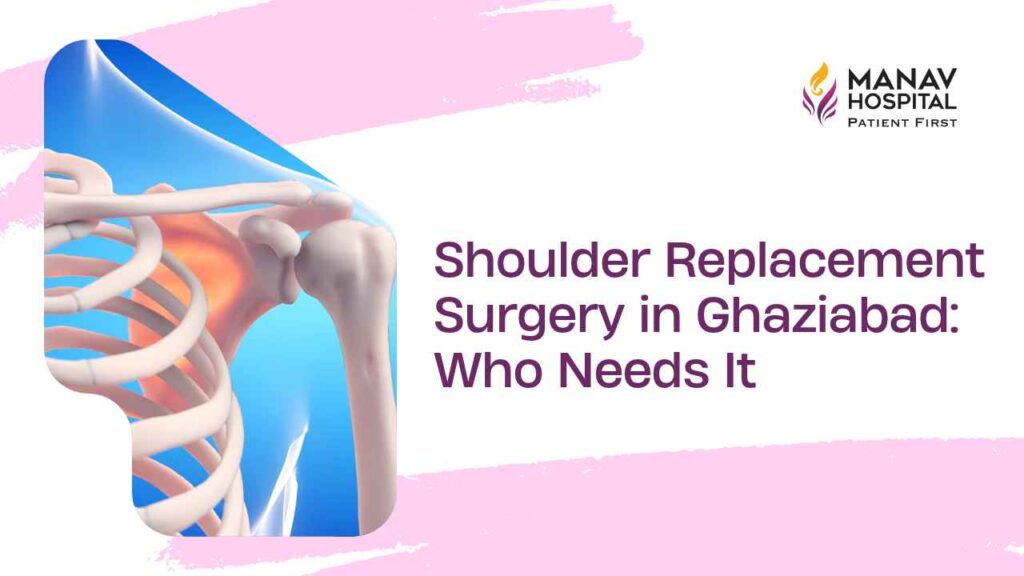
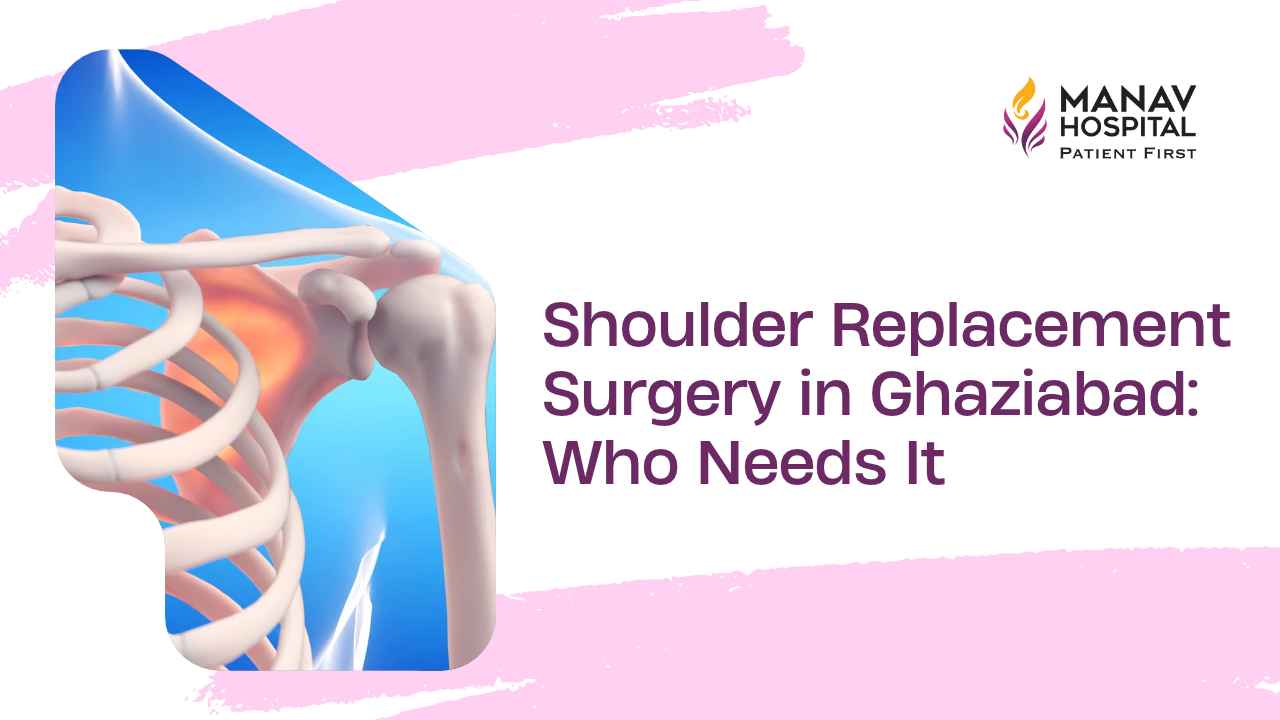
Shoulder replacement surgery in Ghaziabad is considered when a shoulder is so damaged, usually by arthritis, a severe fracture or a rotator cuff problem that can’t be repaired, that pain and stiffness haven’t improved with non-surgical care. The damaged joint surfaces are replaced with an artificial joint. A conventional replacement relies on a working rotator cuff, while a reverse shoulder replacement switches the ball and socket so the deltoid muscle does more of the work. This guide explains who may need it, the main types, recovery, risks and what affects cost. You can request an appointment at Manav Hospital here.
Overview
Here’s a very common story (a hypothetical, but one orthopaedic clinics hear all the time). A 66-year-old retired teacher can’t lift a cup of tea to her mouth without wincing. She can’t comb her hair, and the pain wakes her at night. Physiotherapy helped for a while. Injections helped less each time. Someone suggests a shoulder replacement, and the first thing she asks is, “Is it as big as a knee replacement?”
Shoulder replacements are less talked about than knee or hip replacements, so people often don’t know what to ask. The good news is that the decision follows a fairly clear pattern: try sensible non-surgical care first, find out exactly what’s damaged, then choose an operation that fits that problem.
This guide covers shoulder arthritis and other reasons for surgery, how reverse shoulder replacement differs from a conventional one, how to prepare, what shoulder replacement recovery involves, the main shoulder replacement risks, what shapes shoulder replacement cost in Ghaziabad and the questions to ask. The orthopaedic department at Manav Hospital in Kavi Nagar lists joint replacement and arthroscopy among the work of its orthopaedic surgeon. This is general information, not a diagnosis, and your surgeon’s advice comes first.
What Is Shoulder Replacement Surgery?
In plain words
● The shoulder is a ball-and-socket joint, and surgery replaces damaged parts with an artificial ball and socket
● Sometimes only the ball (the top of the arm bone) is replaced, and sometimes both parts are
● In a conventional replacement, a plastic cup sits in the socket and a metal ball sits on the arm bone
● In a reverse replacement, the positions are switched
● It’s usually considered after non-surgical treatments haven’t relieved pain
Replacing a shoulder is mainly about pain relief and usable movement. Nobody expects a replaced shoulder to feel like a teenager’s.
Meet Dr. Sharad Gupta
Dr. Sharad Gupta is an orthopaedic and arthroplasty surgeon at Manav Hospital. His profile lists an MBBS from Rajiv Gandhi University of Health Sciences (Bangalore), an MS in Orthopaedics from Jawaharlal Nehru Medical College, Wardha, a fellowship in joint replacement surgery from Sunshine Hospital, Hyderabad and a Fellowship in Arthroplasty and Adult Reconstruction from Mt Sinai Hospital, Toronto. Memberships listed include the Indian Orthopaedic Association, Indian Arthroplasty Association, Indian Arthroscopy Society, AO Trauma and SICOT. You can see the hospital’s full doctors listing here.
Professional Highlights
● Joint replacement and revision surgery are among his listed areas of work
● Arthroscopy (keyhole) surgery for the knee and shoulder is also listed
● OPD timings on his profile: Monday to Saturday, 11 am to 2 pm and 5 pm to 7 pm, Sunday off. Please confirm before visiting
● Based at Manav Hospital, 1 B Block, Kavi Nagar, Ghaziabad
Shoulder pain that won’t settle? Book a consultation and bring your X-rays or MRI.
Shoulder Arthritis and Other Reasons for Replacement
Shoulder arthritis is the most common reason, but it isn’t the only one. According to the American Academy of Orthopaedic Surgeons (AAOS), reasons for a reverse replacement include arthritis, a completely torn rotator cuff that can’t be repaired, cuff tear arthropathy, a failed earlier replacement, complex fractures, chronic dislocation and, rarely, tumours.
In everyday terms, surgery may be on the table when:
● Pain is constant and wakes you at night
● Daily tasks are hard, such as dressing, reaching or carrying
● Scans show serious damage, such as worn cartilage or a badly broken joint
● Non-surgical care hasn’t worked, such as medicines, injections and physiotherapy
Not everyone with a painful shoulder needs a replacement. Many shoulder problems, such as tendon irritation or a repairable cuff tear, are managed in other ways. Severe fractures have their own route, covered in our guide to complex fracture surgery. Our guide to arthroscopy (keyhole) surgery shows how some of those problems are treated.
Rotator Cuff Arthropathy: When the Cuff Is the Problem
Rotator cuff arthropathy describes arthritis in a shoulder whose rotator cuff tendons are also badly torn. The shoulder’s ball can ride upward, the joint wears and the arm becomes weak and painful. A conventional replacement depends on a working cuff, so it often isn’t the right choice here. This is where a reverse design comes in.
Reverse Shoulder Replacement: What Is It?
Reverse shoulder replacement switches the ball and socket. The metal ball attaches to the socket side and the cup attaches to the arm bone. AAOS explains that this design relies on the deltoid muscle, instead of the rotator cuff, to power and position the arm.
Hospital for Special Surgery (HSS) says it’s typically considered for a massive rotator cuff tear, shoulder arthropathy, a failed earlier replacement or a complex fracture. It also lists poor candidates, including people with good rotator cuff function, active infection, severe osteoporosis, serious general health problems or unrealistic expectations.
Conventional vs reverse replacement
● Conventional: Needs a working rotator cuff. Ball on the arm bone, cup in the socket
● Reverse: Works when the cuff is badly damaged. Positions switched, deltoid powers the arm
● Choice: Made by the surgeon after examination and imaging, not by preference alone
How to Prepare for Shoulder Replacement
● Get a clear diagnosis from examination, X-rays and, where needed, MRI or CT
● Discuss your health conditions and regular medicines, including blood thinners
● Treat any infections first, including dental or skin ones, as your surgeon advises
● Arrange help at home, because one arm will be in a sling
● Set up your home before surgery, with commonly used items within easy reach
● Ask about physiotherapy before and after the operation
If you smoke, ask your surgeon how to prepare. Smoking can affect healing.
What Happens During Surgery?
HSS says the operation can take between one and three hours. The damaged joint parts are removed and replaced with the artificial joint. An anaesthetist plans the anaesthesia, often general anaesthesia with a nerve block for pain control, though this depends on you and your surgeon. AAOS notes that some patients go home the same day, while most admitted patients go home the next day. HSS says the stay is usually one night. Your hospital’s plan comes first.
Shoulder Replacement Recovery: What to Expect
Shoulder replacement recovery is gradual, and physiotherapy is a big part of it.
The First Days
Your arm will be in a sling when you leave the hospital, according to AAOS. Gentle motion exercises may begin as your surgeon directs. AAOS says most people can eat, dress and groom themselves within a few days.
Weeks One to Six
HSS describes this stage as pain control, wound healing and starting physiotherapy to restore motion. AAOS advises avoiding extreme arm positions, not pushing up from a chair or bed and not lifting heavy weights, with a default of nothing heavier than about 5 pounds (around 2.3 kg) in the first six weeks. Your surgeon’s limits may differ.
Weeks Six to Twelve
Physiotherapy builds strength, and some everyday activities resume with restrictions, according to HSS.
Months Three to Twelve
HSS says many patients show significant improvement in shoulder function between three and six months, and most recover substantially by six to twelve months, though gains can continue past a year. Physiotherapy commonly lasts three to six months.
Driving
HSS says typical guidance is two to four weeks, or until you’re out of the sling, which can be four to six weeks. Ask your surgeon.
Recovery habits that help
● Do your exercises exactly as taught, not harder
● Wear the sling as advised
● Sleep semi-upright if that’s more comfortable
● Don’t lift or push beyond your limits
● Report fever, wound redness or swelling, or sudden new pain
Shoulder Replacement Risks
All surgery carries risks. According to AAOS, these include bleeding, nerve damage and infection, plus device-related problems such as wear, loosening, stress fractures or dislocation of the components, which may need further surgery. HSS adds persistent pain, limited movement, especially reaching behind the back, rare implant allergy and blood clots. It also says some loss of motion may persist.
Results vary, and no outcome is guaranteed. Ask your surgeon how these shoulder replacement risks apply to your age, bone quality and health.
Shoulder Replacement Cost Ghaziabad: What Shapes the Bill
Shoulder replacement cost in Ghaziabad depends on many factors, so treat any single number with caution. The bill is usually shaped by:
● The type of replacement (conventional, reverse or partial)
● The implant brand and design
● Surgeon, anaesthesia and operation theatre charges
● Room type and length of stay
● Tests, scans and medicines
● Physiotherapy before and after surgery
● Insurance cover and any approval process
Manav Hospital’s site lists TPA and cashless support for patients with mediclaim or health insurance, but please confirm your cover and get an itemised estimate before surgery. Ask what’s included, what’s excluded and what happens if there’s a complication.

Questions to Ask Before Shoulder Replacement
● What exactly is damaged, and is it arthritis, the rotator cuff or both?
● Have non-surgical options been tried properly?
● Would you suggest a conventional or reverse replacement, and why?
● How many shoulder replacements have you done, and does the hospital do them regularly?
● What movement can I realistically expect afterwards?
● What does physiotherapy look like, and how long will it take?
● What are my specific risks?
● What does the estimate include?
For a wider look at what a hospital should offer for joint surgery, read what a hospital should have before you trust it with knee replacement. The same questions about staff, facilities and rehabilitation apply here. You can also read about the hospital’s facilities and its physiotherapy department.
Why Choose Manav Hospital for Shoulder Care?
Key advantages
● A dedicated orthopaedic department
● A surgeon whose profile lists joint replacement, arthroscopy and fellowship training in arthroplasty
● Physiotherapy department on site
● Imaging, operation theatres and ICU listed in the hospital’s facilities
● TPA and cashless support for patients with mediclaim or health insurance, as listed on the site. Please confirm cover with the hospital
Learn more about orthopaedic care at Manav Hospital, or book an appointment.
What Are the Benefits of Getting Shoulder Pain Assessed Early?
✔ A clear diagnosis of what’s actually damaged
✔ A chance to try the right non-surgical care first
✔ A realistic discussion of conventional vs reverse options
✔ A rehab plan you understand before surgery
✔ A cost estimate with no surprises
Staying Informed
Manav Hospital shares updates on Facebook, Instagram, YouTube and LinkedIn. Results vary from person to person, and no outcome is guaranteed.
Why Do Ghaziabad Patients Choose Manav Hospital?
● Multi-speciality care under one roof, from orthopaedics to ophthalmology and dental
● A 24×7 emergency ambulance and helpline listed on +91-9718942666
● Easy access in Kavi Nagar, near State Bank of India and the Post Office
● A listed orthopaedic surgeon with arthroscopy and arthroplasty training
● Online appointment and booking through the website
Conclusion
Shoulder replacement surgery in Ghaziabad is for a particular group: people whose shoulders are badly damaged and who haven’t improved with non-surgical care. Get a precise diagnosis, understand whether a conventional or reverse replacement fits, plan your rehab and ask for a clear estimate. If shoulder pain is limiting your daily life, Manav Hospital’s orthopaedic team can assess it, and you can contact the hospital to ask about appointments.
Contact Manav Hospital
Address: 1, B Block, Kavi Nagar, Ghaziabad, Uttar Pradesh 201002
Phone and 24×7 emergency helpline: +91-9718942666
Email: info.manavhospital@gmail.com
Follow on: Facebook | Instagram | YouTube
Book your shoulder consultation at Manav Hospital here
FAQs
Who needs shoulder replacement surgery in Ghaziabad?
People with severe shoulder damage, such as arthritis, an irreparable rotator cuff tear or a complex fracture, whose pain hasn’t eased with non-surgical care. A surgeon decides after examination and imaging.
What is a reverse shoulder replacement?
An operation that switches the ball and socket so the deltoid muscle, rather than the rotator cuff, powers the arm. It’s often used when the cuff is badly damaged.
Can shoulder arthritis be treated without surgery?
Often at first. Medicines, injections and physiotherapy are tried before surgery is considered, though they don’t suit everyone.
How long is shoulder replacement recovery?
HSS says most people recover substantially by six to twelve months, with physiotherapy commonly lasting three to six months. It varies.
What are the main shoulder replacement risks?
Infection, bleeding, nerve injury, implant loosening, dislocation, fracture and persistent pain or stiffness, among others. Results vary, and no outcome is guaranteed.
What decides shoulder replacement cost in Ghaziabad?
The type of replacement, implant, stay, tests, physiotherapy and insurance. Ask for an itemised estimate.
What is rotator cuff arthropathy?
Arthritis in a shoulder that also has a severely damaged rotator cuff. You can contact the hospital to discuss your case.