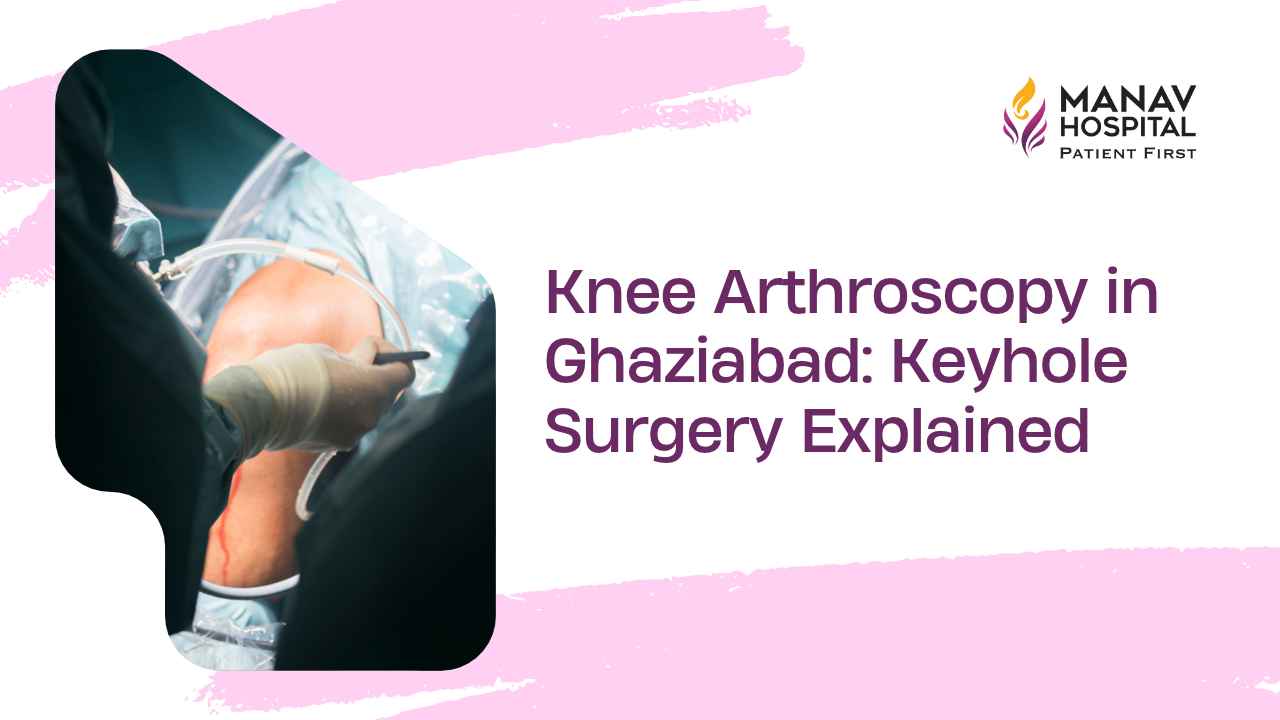
Knee arthroscopy is keyhole knee surgery in which a surgeon looks inside the joint with a small camera and, if needed, treats the problem through tiny cuts instead of one large incision. It’s commonly used for meniscus tears, ligament injuries, loose fragments and some cartilage damage. It isn’t a general fix for every painful knee, and for arthritis in particular, large reviews have advised against it. This guide explains what happens, who may benefit, what recovery looks like and what to ask before booking. You can request an appointment at Manav Hospital here.
Overview
Here’s a very common story (a hypothetical, but you’ve probably heard it). A 35-year-old gets his knee twisted during a weekend cricket match. The swelling goes down, but for weeks the knee catches when he climbs stairs and sometimes locks for a second. A friend says, “Just get the keyhole thing done.” Another says, “Don’t let anyone cut your knee, it’ll settle.” Both sound sure. Neither has seen his MRI.
That’s the problem with arthroscopy. Keyhole knee surgery is a very useful tool for the right problem and a poor answer to the wrong one. So the useful question isn’t “should I get keyhole surgery?” It’s “what exactly is wrong inside my knee, and will looking and fixing it from inside help?”
This guide covers what arthroscopy is, what it can treat, when it’s not recommended, how arthroscopy vs open surgery compares, the steps of the operation, arthroscopy recovery, knee arthroscopy risks, what drives arthroscopy cost and the questions to ask. The orthopaedic department at Manav Hospital in Kavi Nagar lists arthroscopy (keyhole) surgery among its services. This is general information, not a diagnosis. Your own surgeon’s advice comes first.
What Is Knee Arthroscopy?
In plain words
● A surgeon makes a few small cuts, called portals, around the knee
● A thin camera, the arthroscope, shows the inside of the joint on a screen
● If treatment is needed, small instruments are passed through other portals
● It can be used to look (diagnose), to repair, or both
● Smaller cuts usually mean less pain and stiffness than open surgery, according to the American Academy of Orthopaedic Surgeons (AAOS)
Arthroscopy is a way of doing the surgery. It isn’t a treatment in itself. What matters is what the surgeon does once inside.
Meet Dr. Sharad Gupta
Dr. Sharad Gupta is an orthopaedic and arthroplasty surgeon at Manav Hospital. His profile lists an MBBS from Rajiv Gandhi University of Health Sciences (Bangalore), an MS in Orthopaedics from Jawaharlal Nehru Medical College, Wardha, a fellowship in joint replacement surgery from Sunshine Hospital, Hyderabad and a Fellowship in Arthroplasty and Adult Reconstruction from Mt Sinai Hospital, Toronto. Memberships listed include the Indian Orthopaedic Association, Indian Arthroplasty Association, Indian Arthroscopy Society, AO Trauma and SICOT.
Professional Highlights
● Arthroscopy (keyhole) surgery for the knee and shoulder is among his listed areas of work
● Also lists joint replacement, revision surgery and complex fractures
● OPD timings on his profile: Monday to Saturday, 11 am to 2 pm and 5 pm to 7 pm, Sunday off. Please confirm before visiting
● Based at Manav Hospital, 1 B Block, Kavi Nagar, Ghaziabad
Knee catching, locking or giving way? Book a consultation and bring any X-ray or MRI you already have.
What Can Keyhole Knee Surgery Treat?
AAOS lists a range of problems that arthroscopy is used for, including:
● Meniscus tears, treated by removing or repairing the damaged part
● ACL or PCL ligament reconstruction
● Removal of inflamed joint lining (synovium)
● Trimming or repairing damaged cartilage
● Removal of loose pieces of bone or cartilage
● Some kneecap (patella) problems
● Knee joint infection
For two of these, Manav Hospital has dedicated guides: ACL reconstruction and meniscus repair surgery. In many of these cases, surgery is usually considered when pain or symptoms haven’t improved with non-surgical care such as rest, physiotherapy, medicines or injections, as AAOS describes.
When Arthroscopy Is Not the Answer
This section matters most, because it’s where people get misled.
A BMJ clinical practice guideline published in 2017, reported by the American Physical Therapy Association, made a strong recommendation against arthroscopic surgery for nearly all patients with degenerative knee disease, including knee osteoarthritis and degenerative meniscal tears. In plain terms, scraping or trimming an arthritic knee through the keyhole hasn’t been shown to help most people more than non-surgical care.
That doesn’t mean arthroscopy is useless. It means:
● Worn, arthritic knees usually need a different plan, such as exercise, weight management, medicines, injections or, later, joint replacement. See our guide on how to know if you need knee replacement
● Age-related meniscus wear often does well with physiotherapy first
● Injury-related problems, such as a fresh locking meniscus tear or a torn ligament, are different and may be good candidates
AAOS also notes that some knee damage can’t be completely reversed with arthroscopic surgery, and that larger operations may sometimes be needed later. A good surgeon should be willing to tell you when keyhole surgery won’t help.
Arthroscopy vs Open Surgery: What’s the Difference?
Arthroscopy vs open surgery comes down to access.
Arthroscopy (keyhole)
● A few small cuts and a camera
● Generally less pain and stiffness after surgery, according to AAOS
● Often done as day surgery, though your hospital and surgeon decide
● Suited to problems the camera and small instruments can reach
Open surgery
● A larger incision that gives direct access
● Used when the problem is too large or complex for the keyhole approach, or when a different operation, such as joint replacement, is needed
● Usually a longer recovery
Neither is automatically better. The right route depends on the problem. If a surgeon recommends open surgery, ask why keyhole isn’t suitable.
How Is the Surgery Done?
Based on the AAOS description, a typical knee arthroscopy goes like this:
● Anaesthesia: Local, regional or general. The surgeon and anaesthetist choose, based on you and the procedure
● Positioning: The skin is cleaned and covered, and the leg may be held steady
● Portals: Small cuts are made around the knee
● Fluid: A sterile solution fills the joint so the surgeon can see clearly
● Looking inside: The arthroscope shows the joint on a screen
● Treatment: Small instruments are used to trim, repair, remove or reconstruct as needed
● Closing: The cuts are closed with stitches or strips and covered with a soft dressing
AAOS says most procedures take under an hour, though length varies with what’s being done.
Arthroscopy Recovery: What to Expect
Arthroscopy recovery depends on what was done inside the knee. Trimming a small piece of meniscus is a very different recovery from rebuilding a ligament.
The First Days
● Rest, keep the leg raised and use ice as your surgeon advises
● You may need crutches, with weight-bearing limits set by your surgeon
● Keep dressings clean and dry
● Take pain relief as prescribed
The First Weeks
● Gentle exercises to restore movement and wake up the thigh muscle
● A follow-up visit to review findings and plan rehabilitation
● AAOS notes driving is typically possible one to three weeks after a minor procedure, and later after bigger repairs. The NHS says you shouldn’t drive until you can do an emergency stop, and not at all after a general anaesthetic. Ask your surgeon
Returning to Normal Life
AAOS says most people return to most activities in about six to eight weeks, unless they had a ligament reconstruction, meniscus repair or cartilage restoration, which take longer. The NHS gives a wider range, from about a week to several months, depending on the procedure and your health. High-impact sport may need to wait longer.
Physiotherapy often makes a difference. AAOS says a formal physical therapy programme may improve your final result. Manav Hospital has a physiotherapy department on site, headed by Dr. Akash Saxena (BPT, MPT).
Recovery habits that help
● Do your exercises daily, not only on clinic days
● Follow weight-bearing and brace instructions exactly
● Don’t rush back to sport because the knee “feels fine”
Knee Arthroscopy Risks
AAOS describes the complication rate as very low, and most complications are minor. NHS lists rare risks including reaction to anaesthetic, joint pain or numbness, blood clots and infection. Others mentioned by AAOS include knee stiffness, blood collecting in the knee, and bruising or swelling.
Contact your surgeon or hospital urgently if you notice
● Fever, or feeling hot, cold or shivery
● Severe or worsening pain in the joint
● Smelly fluid leaking from the wound
● Severe or spreading swelling or redness
● Numbness or tingling around the knee
Results vary, and no outcome is guaranteed. Ask your surgeon how these risks apply to you.
Arthroscopy Cost: What Affects the Bill
Arthroscopy cost differs between hospitals and patients, so be wary of a single quoted figure. Factors usually include:
● What’s being done: a diagnostic look, a meniscus procedure or a ligament reconstruction
● Implants, anchors or grafts, if needed
● The type of anaesthesia and the length of the operation
● Room type and length of stay
● Investigations such as MRI, tests and follow-up visits
● Physiotherapy after surgery
● Your insurance cover
Manav Hospital’s site lists TPA and cashless support for patients with mediclaim or health insurance, but please confirm your cover and the likely cost with the hospital before the procedure. Ask for an itemised estimate and what it includes and excludes. The hospital’s facilities page describes what’s available on site.
Questions to Ask Before Knee Arthroscopy
● What exactly is wrong inside my knee, and what does my MRI show?
● Will keyhole surgery help this problem, or would rehab or another approach be reasonable first?
● What will you do inside the knee, and could that change once you see it?
● Is arthroscopy or open surgery more suitable for me, and why?
● What’s the rehabilitation plan, and when can I drive, work and exercise?
● What are the risks in my situation?
● What does the estimate include?
For more on choosing a surgeon, read what to look for in a knee orthopaedic surgeon in Ghaziabad and when to see a knee surgeon.
Why Choose Manav Hospital for Knee Arthroscopy?
Key advantages
● A dedicated orthopaedic department listing arthroscopy among its services
● A surgeon with arthroscopy listed in his profile and fellowship training in arthroplasty
● Physiotherapy department on site
● Imaging, operation theatres and ICU listed in the hospital’s facilities
● TPA and cashless support for patients with mediclaim or health insurance, as listed on the site. Please confirm cover with the hospital
Learn more about orthopaedic care at Manav Hospital, or book an appointment.
What Are the Benefits of Getting the Knee Assessed Properly First?
✔ A clear diagnosis before deciding on surgery
✔ Avoiding an operation that wouldn’t help
✔ A rehab plan that starts at the right time
✔ A realistic recovery timeline
✔ An estimate you understand
Staying Informed
Manav Hospital shares updates on Facebook, Instagram, YouTube and LinkedIn. Results vary from person to person, and no outcome is guaranteed.
Why Do Ghaziabad Patients Choose Manav Hospital?
● Multi-speciality care under one roof, from orthopaedics to ophthalmology and dental
● A 24×7 emergency ambulance and helpline listed on +91-9718942666
● Easy access in Kavi Nagar, near State Bank of India and the Post Office
● A listed orthopaedic surgeon with arthroscopy and arthroplasty training
● Online appointment and booking through the website
Conclusion
Knee arthroscopy in Ghaziabad can be a very useful operation when the problem is one the camera can fix, such as a torn meniscus or ligament. It’s not a shortcut for a worn, arthritic knee. Get the diagnosis right, understand what will be done inside, plan your recovery and ask for a clear estimate. If your knee catches, locks or gives way, Manav Hospital’s orthopaedic team can assess it.
Contact Manav Hospital
Address: 1, B Block, Kavi Nagar, Ghaziabad, Uttar Pradesh 201002
Phone and 24×7 emergency helpline: +91-9718942666
Email: info.manavhospital@gmail.com
Follow on: Facebook | Instagram | YouTube
Book your knee consultation at Manav Hospital here
FAQs
What is knee arthroscopy in Ghaziabad?
It’s keyhole surgery in which a camera and small instruments are used through tiny cuts to diagnose or treat knee problems. Manav Hospital lists arthroscopy among its orthopaedic services.
Is arthroscopy in Ghaziabad suitable for knee arthritis?
Usually not. A 2017 BMJ guideline, as reported by APTA, strongly recommended against arthroscopy for nearly all patients with degenerative knee disease. Ask your surgeon what suits your knee.
What is keyhole knee surgery used for?
Meniscus tears, ligament reconstruction, loose fragments, some cartilage problems, inflamed joint lining and infection, according to AAOS.
How long is arthroscopy recovery?
AAOS says most people return to most activities in about six to eight weeks, longer after ligament or meniscus repair. The NHS gives a range from about a week to several months. It varies.
What are the main knee arthroscopy risks?
Complications are described as rare, and include infection, blood clots, stiffness, bruising, swelling and joint pain or numbness. Results vary, and no outcome is guaranteed.
What decides arthroscopy cost?
The procedure, implants, anaesthesia, stay, tests, physiotherapy and insurance. Ask for an itemised estimate from the hospital.
Arthroscopy vs open surgery: which is better?
Neither is better for everyone. Keyhole surgery generally means smaller cuts and less stiffness, but some problems need open surgery. You can contact the hospital to discuss your case.