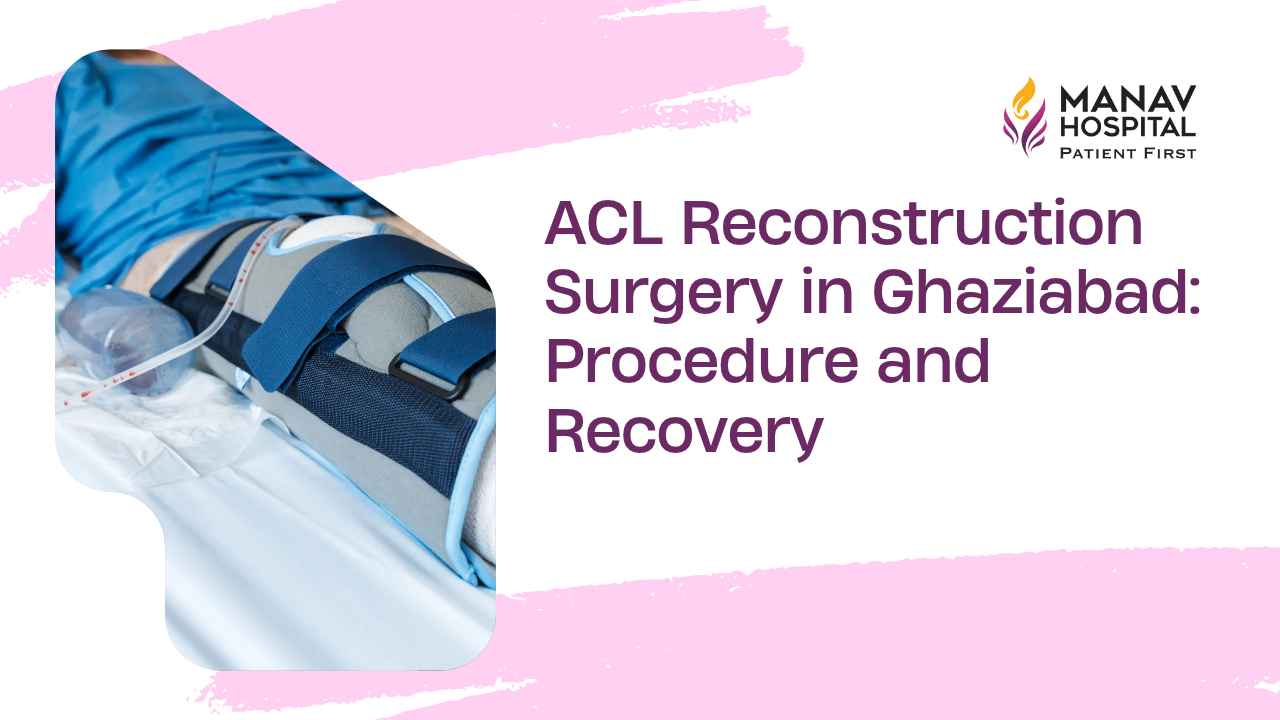
ACL reconstruction is a keyhole (arthroscopic) operation in which a torn anterior cruciate ligament is replaced with a tissue graft, because a torn ACL cannot usually be stitched back together. It is generally advised for younger, active people with a knee that keeps giving way, while some older or less active patients manage with physiotherapy and bracing. Most people need around six months or more before returning to sport, and full recovery depends on rehab. You can request an appointment at Manav Hospital here.
Overview
Picture this (a hypothetical, but a very familiar one). It’s a Sunday morning football match. You plant your foot, turn sharply, and hear a pop. The knee gives way, swells up by evening, and by Monday you’re limping to the office wondering whether it’s “just a sprain”.
Sometimes it is. Sometimes it’s the ACL. And the tricky part is that after the first week of pain, the knee can feel almost normal while still being unstable. People go back to sport, the knee buckles again, and each buckle can damage the cartilage and meniscus a little more.
That’s why it helps to understand the injury early. This guide explains what the ACL does, how to recognise a tear, when surgery is advised and when it isn’t, how graft choices work, what the operation and recovery look like, and which questions to take to your surgeon. The orthopaedic department at Manav Hospital in Kavi Nagar, Ghaziabad lists ACL reconstruction surgery among its procedures, performed by Dr. Sharad Gupta. This is general information, not a diagnosis, and your own surgeon’s advice comes first.
What Is the ACL, and What Happens When It Tears?
In plain words
● The anterior cruciate ligament (ACL) sits in the middle of your knee
● It stops the shinbone from sliding forward under the thighbone, and it helps control twisting
● Most tears happen during sudden stops, pivots, awkward jump landings, falls or direct blows
● A tear can be partial or complete, and nearby cartilage or ligaments may be hurt too
● A completely torn ACL does not heal on its own
The pain settles. The instability doesn’t. That’s the part to take seriously.
Meet Dr. Sharad Gupta
Dr. Sharad Gupta is an orthopaedic and arthroplasty surgeon at Manav Hospital. His profile lists an MBBS from Rajiv Gandhi University of Health Sciences (Bangalore), an MS in Orthopaedics from Jawaharlal Nehru Medical College, Wardha, a fellowship in joint replacement surgery from Sunshine Hospital, Hyderabad and a Fellowship in Arthroplasty and Adult Reconstruction from Mt Sinai Hospital, Toronto. Memberships listed include the Indian Orthopaedic Association, Indian Arthroplasty Association, Indian Arthroscopy Society, AO Trauma and SICOT.
Professional Highlights
● Arthroscopy (keyhole) surgery for the knee and shoulder is among his listed areas of work
● Also lists joint replacement, revision surgery and complex fractures
● OPD timings on his profile: Monday to Saturday, 11 am to 2 pm and 5 pm to 7 pm, Sunday off. Please confirm before visiting
● Based at Manav Hospital, 1 B Block, Kavi Nagar, Ghaziabad
Think your knee gave way for a reason? Book a consultation and bring any X-ray or MRI you already have.
ACL Tear Symptoms: How to Recognise One
● A pop or tearing feeling at the moment of injury
● Sudden, sharp pain
● Swelling within about 24 hours
● A feeling that the knee is wobbly, or “going out” when you turn
● Pain and difficulty when walking
● Reduced range of motion
Instability is often the most telling sign. A swollen, locked or unstable knee after a twisting injury should be examined by an orthopaedic doctor rather than waiting it out.
Get seen soon if
● The knee gives way on stairs, turns or even while walking
● It swells again after each return to activity
● You can’t straighten or fully bend it
● You also notice catching or locking, which can point to a meniscus tear. See our guide on meniscus tear repair or removal
Go to an emergency department if
● The knee looks deformed after a fall or collision
● You can’t put any weight on the leg
● The foot turns pale, cold or numb
How Is a Torn ACL Diagnosed?
A doctor will ask how the injury happened and examine the knee with hands-on stability tests. An X-ray is usually done to rule out a fracture, and an MRI shows the ligament and any meniscus or cartilage damage. Together, these decide whether the tear is partial or complete and what else is involved.
Does Everyone With an ACL Tear Need Surgery?
No. And any surgeon who says “everyone” is oversimplifying.
Manav Hospital’s ACL page notes that surgery is generally recommended for younger, active patients, while non-surgical care may suit older patients or those with an otherwise intact knee. A well-known orthopaedic centre, Hospital for Special Surgery, notes that some partial tears in young patients can heal without surgery, and that older or less active people who don’t do much pivoting may return to normal life without it.
Surgery is more likely to be advised if
● You’re young and play sports with cutting, jumping or pivoting
● The knee keeps giving way during everyday movement
● The tear is complete
● There’s an associated meniscus or ligament injury
● Your job involves uneven ground, ladders or heavy physical work
Non-surgical care may be reasonable if
● The tear is partial and the knee feels stable
● You’re less active or older, and you don’t pivot much
● You’re willing to commit to a structured rehabilitation programme
● Your surgeon feels the knee is functionally stable
Non-surgical care usually means a brace, crutches for a short time and physiotherapy with a rehabilitation exercise programme. The clinic’s physiotherapy department is headed by Dr. Akash Saxena (BPT, MPT).
When Should You Have the Surgery?
Not on day one. Surgeons usually wait for swelling to settle and for movement to return, because operating on a stiff, swollen knee can cause scarring and stiffness. Many people have surgery a few weeks after the injury, after working on strength and motion first.
But waiting indefinitely isn’t ideal either. Hospital for Special Surgery notes that delaying beyond about three months raises the risk of cartilage and meniscus damage from ongoing instability. So the sweet spot is “not too early, not too late”, and your surgeon will guide that timing.
ACL Reconstruction: Graft Options Explained
Because a torn ACL can’t be stitched back together, the surgeon builds a new one from a tissue graft. Manav Hospital’s page lists these options.
1. Patellar Tendon Graft
Taken from the tendon between the kneecap and shinbone. It is described on the page as the most common choice.
2. Hamstring Tendon Graft
Taken from the back of the thigh. Often chosen when someone wants to avoid problems at the front of the knee.
3. Quadriceps Tendon Graft
Taken from the tendon between the thigh muscle and kneecap.
4. Donor (Cadaver) Graft
Donor tissue is an option in some cases. Orthopaedic centres such as Hospital for Special Surgery advise against it in young patients, because of a higher risk of reinjury and graft failure.
How graft choice is usually made
● Age and activity level
● Your sport or job
● Previous surgeries or injuries to the knee
● Surgeon’s experience and your preference after discussion
Each graft has pros and cons, such as where the pain is felt afterwards and how the donor site recovers. There’s no single winner for everyone, so ask your surgeon why a particular graft suits you.
What Happens During ACL Reconstruction?
● Anaesthesia: Decided by the anaesthetist, based on your health and the plan
● Keyhole approach: The surgeon uses an arthroscope (a small camera) through tiny cuts and works on the joint on a screen
● Treating other damage: Any meniscus tear or cartilage injury can be dealt with at the same time
● Graft placement: The graft is positioned and fixed in tunnels in the thighbone and shinbone
● Closure and dressing: The knee is bandaged, and a brace may be fitted
The hospital’s page lists modular operating theatres with HEPA filtration, a high-definition arthroscope and camera, C-arm imaging, a shaver system and a digitally controlled tourniquet among its equipment. As with any operation, results depend on the patient, the surgeon and rehabilitation, and no outcome can be guaranteed.
ACL Recovery: What to Expect
Surgery is only half the story. Rehab does the rest.
The First Days
Expect pain, swelling and stiffness. You’ll usually be walking with crutches or a brace, depending on your surgeon’s advice. Hospital for Special Surgery notes that rehab often starts within two to three days.
The First Weeks
The focus is on controlling swelling, regaining knee movement and waking up the thigh muscle. Don’t skip this stage. Stiffness is a recognised problem when motion isn’t restored.
Months Two to Five
Strength work builds up. Running exercises often begin somewhere around three to five months, if your surgeon and physiotherapist are happy with your strength and control.
Months Five to Nine and Beyond
Pivoting and sport-specific drills are added later. Hospital for Special Surgery suggests that full return often takes 9 to 12 months, with cutting sports at the later end. Manav Hospital’s ACL page says return to an active sports lifestyle takes around six months or more. The honest summary: it varies, it’s slow and it’s decided by tests of strength and control, not by the calendar.
Recovery habits that help
● Do your physiotherapy exercises daily, not only on clinic days
● Keep the knee elevated and use cold packs as advised
● Follow weight-bearing and brace instructions exactly
● Eat enough protein, and sleep properly
● Don’t return to sport because the knee “feels fine”. Get cleared first
Risks to Understand
● Infection, bleeding and blood clots, as with any surgery
● Knee stiffness or scarring
● Pain at the graft site
● Graft stretching, failure or reinjury
● Ongoing instability if rehab is incomplete
● Cartilage or meniscus problems if surgery is delayed too long
● A longer-term chance of knee arthritis after a significant knee injury, even with surgery
Your surgeon should explain how these apply to you.
Questions to Ask Before ACL Surgery
● Is my tear partial or complete, and what else is damaged?
● Do I really need surgery, or can I try rehab first?
● Which graft do you suggest, and why?
● Will you treat the meniscus at the same time?
● What does the rehab plan look like, week by week?
● When can I realistically return to my sport or job?
● Does the hospital have physiotherapy, imaging and insurance support in one place? You can read about the facilities here
If you’re still comparing options for other knee problems, our guide on how to know if you actually need knee replacement may help, and what to look for in a knee orthopaedic surgeon is useful before any consultation.

Why Choose Manav Hospital for ACL Care?
Key advantages
● A dedicated orthopaedic department with arthroscopy and ACL reconstruction listed among services
● A surgeon with arthroscopy listed in his profile and fellowship training in arthroplasty
● Physiotherapy department on site
● Imaging, operation theatres and ICU listed in the hospital’s facilities
● TPA and cashless support for patients with mediclaim or health insurance, as listed on the site. Please confirm cover with the hospital
Learn more about arthroscopy (keyhole) surgery, or book an appointment.
What Are the Benefits of Getting an ACL Injury Assessed Early?
✔ A clear diagnosis rather than guessing “sprain”
✔ A better chance of protecting the meniscus and cartilage
✔ A rehab plan that starts at the right time
✔ A realistic return-to-sport timeline
✔ Less risk of repeated giving-way episodes
Staying Informed
Manav Hospital shares updates on Facebook, Instagram, YouTube and LinkedIn. Results vary from person to person, and no outcome is guaranteed.
Why Do Ghaziabad Patients Choose Manav Hospital?
● Multi-speciality care under one roof, from orthopaedics to ophthalmology and dental
● A 24×7 emergency ambulance and helpline listed on +91-9718942666
● Easy access in Kavi Nagar, near State Bank of India and the Post Office
● A listed orthopaedic surgeon with arthroscopy and arthroplasty training
● Online appointment and booking through the website
Conclusion
A torn ACL isn’t just a sports injury. It’s a stability problem, and how you handle it decides how your knee behaves for years. Get the diagnosis right, work out whether surgery or structured rehab suits your life, choose the graft with your surgeon and treat the rehab as the real work. If your knee has been giving way, Manav Hospital’s orthopaedic team can assess it.
Contact Manav Hospital
Address: 1, B Block, Kavi Nagar, Ghaziabad, Uttar Pradesh 201002
Phone and 24×7 emergency helpline: +91-9718942666
Email: info.manavhospital@gmail.com
Follow on: Facebook | Instagram | YouTube
Book your knee consultation at Manav Hospital here
FAQs
Can a torn ACL heal without surgery?
A completely torn ACL does not heal on its own. Some partial tears, and some older or less active patients, do well with bracing and physiotherapy. Your surgeon will advise based on your knee and lifestyle.
How long is recovery after ACL reconstruction?
Walking returns early, but sport takes longer. Manav Hospital’s page mentions around six months or more, and some medical centres suggest 9 to 12 months for cutting sports. It depends on rehab and strength tests.
Which graft is used for ACL surgery?
Common options are the patellar tendon, hamstring tendons, quadriceps tendon and, in some cases, donor tissue. The choice depends on your age, activity and surgeon’s advice.
Is ACL surgery done with keyhole technique?
Yes. It is done arthroscopically through small incisions, which the hospital’s page describes as less invasive.
How soon should I have surgery after an ACL injury?
Usually after swelling settles and movement returns, rather than immediately. Waiting too long can raise the risk of other knee damage, so timing should be planned with your surgeon.
Can I play sport again after ACL reconstruction?
Many people return to sport, but only after rehab and strength and stability checks. Risk of reinjury remains, so follow your surgeon’s clearance. You can contact the hospital to discuss your case.