A complex fracture is a serious break where the bone is in several pieces, displaced, open through the skin or surrounded by badly injured tissue. Surgery aims to restore alignment and stability using plates, screws, rods, ring or external fixation, sometimes with bone grafting. Bone union often takes weeks to months, and full functional recovery can take much longer than that, depending on the bone, the injury, your health and rehab. You can request an appointment at Manav Hospital here.
Overview
Imagine a road accident, or a bad fall from a ladder (a hypothetical, but not an unusual one). At the hospital, the X-ray shows the bone in several pieces, and the doctor uses a phrase you’ve never wanted to hear: “complex fracture”.
Then the questions flood in. Will it need an operation? Plates, rods or a frame? How long before I can walk? Will I be able to work again? Why does my cousin’s cast-only break take six weeks while this one seems to take months?
The honest answer is that complex fractures are different from simple ones. The break is only part of the injury. The skin, muscles, nerves and blood supply matter just as much, and that shapes both the surgery and the recovery. This guide explains what makes a fracture complex, how surgeons decide between fixation methods, what healing really looks like, why some bones take longer than others, and how to prepare. Manav Hospital in Kavi Nagar, Ghaziabad lists complex fracture surgery among its orthopaedic services, under Dr. Sharad Gupta. This is general information, not a diagnosis.
What Makes a Fracture “Complex”?
In plain words
● The bone is broken into several fragments (comminuted), not one clean line
● Pieces may be shifted, rotated or shortened (displaced)
● The skin may be broken (open fracture), which raises infection risk
● The break may reach a joint, which makes alignment critical
● Muscle, nerves, blood vessels or skin may be badly damaged too
● Weak bone, as in osteoporosis, can make even a fall serious
Complex means complicated to fix and complicated to heal. It doesn’t mean hopeless.
Meet Dr. Sharad Gupta
Dr. Sharad Gupta is an orthopaedic and arthroplasty surgeon at Manav Hospital. His profile lists an MBBS from Rajiv Gandhi University of Health Sciences (Bangalore), an MS in Orthopaedics from Jawaharlal Nehru Medical College, Wardha, a fellowship from Sunshine Hospital, Hyderabad and a Fellowship in Arthroplasty and Adult Reconstruction from Mt Sinai Hospital, Toronto. He lists complex fractures among his areas of work and holds memberships including the Indian Orthopaedic Association and AO Trauma.
Professional Highlights
● Evaluates the injury and plans treatment for complex fractures at Manav Hospital
● Also lists arthroscopy, joint replacement and revision surgery
● OPD timings on his profile: Monday to Saturday, 11 am to 2 pm and 5 pm to 7 pm, Sunday off. Please confirm before visiting
● Based at Manav Hospital, 1 B Block, Kavi Nagar, Ghaziabad
Had an injury and unsure about next steps? Book a consultation and bring all X-rays and CT scans.
When Is Surgery Needed for a Fracture?
Many simple, stable breaks heal well in a cast or splint. Surgery is usually considered when:
● The bone is displaced, or fragments won’t stay aligned
● The break involves a joint surface
● The fracture is open
● There are multiple fragments, or bone loss
● A cast alone wouldn’t hold the bone in a good position
● Nerves or blood vessels are affected
● An earlier fracture has failed to heal (nonunion) or healed in a poor position (malunion)
Your surgeon decides this from examination and imaging. Time matters, so don’t delay medical care after a significant injury.
Go to an emergency department straight away if
● The bone has pierced the skin, or you see a deep wound
● The limb looks deformed, or the foot or hand is pale, cold or numb
● Pain is severe and getting worse, or the limb feels very tense and swollen
● You can’t move the injured area at all
Manav Hospital lists a 24×7 ambulance and helpline on +91-9718942666.
How Are Complex Fractures Assessed?
● Examination: Checking skin, circulation, sensation and movement
● X-rays: To see alignment and fracture pattern
● CT scan: Helpful for joint fractures and multiple fragments. The hospital’s page mentions 3D CT scans for planning
● MRI or other tests: When soft tissues or blood vessels are in question
● General health checks: Blood tests, sugar control and heart and lung fitness before anaesthesia
Fixation Methods: How Surgeons Hold Bones Together
There isn’t one best method for every break. The choice depends on the bone, the pattern, the skin and your health. These are the options Manav Hospital’s page describes, along with common orthopaedic practice.
Plates and Screws
Metal plates are fixed to the bone with screws to hold fragments in position while they heal. Common for fractures near joints and in the forearm, ankle and other long bones.
Rods (Intramedullary Nails)
A rod passes inside the hollow of a long bone to hold it. Often used in long bones such as the thigh or shin. This is general practice, though the hospital’s page lists plates, screws and rods as baseline options.
External Fixation
A frame outside the limb holds the bone through pins. It’s often used when the skin is badly damaged, there’s infection risk or the injury is too swollen for a definitive operation.
Ring Fixation
A circular frame around the limb, used in complex situations. Manav Hospital’s page describes it as less intrusive, with lower infection risk in the long run.
Dynamic Fixation
A method that allows some controlled movement at the fracture, which may help in certain fractures to promote healing. Suitability depends on the case.
Bone Grafting and Biologics
When bone is missing or healing is slow, a bone graft may be used. The hospital’s page also lists restorative techniques such as the Masquelet method and biologics for bone loss.
Antibiotic-Treated and 3D-Printed Implants
The page lists antibiotic-treated implants for patients at higher infection risk, and 3D-printed implants for complex reconstructions planned with 3D imaging. Whether these suit you is a surgeon’s decision, and not every injury needs them.
Fixation isn’t about the fanciest option. It’s about the right option for your bone, your skin and your life.
Staged Surgery: Why You May Need More Than One Operation
With severe swelling or contaminated wounds, surgeons often do the job in stages. First comes cleaning the wound (debridement) and stabilising the bone, sometimes with an external frame. Once the skin and swelling settle, a definitive fixation follows. It can feel frustrating, but it’s often safer.
Fracture Healing Time: What to Expect
Here’s the part everyone asks about, and the part nobody can promise. Bone heals in overlapping stages: inflammation, soft callus, hard callus and remodelling. Typical union times quoted in medical references vary by site. For example, a distal radius (wrist) often takes about 8 to 12 weeks, a proximal humerus (upper arm) 10 to 16 weeks, a tibial shaft (shin) 16 to 24 weeks and a heel bone (calcaneus) 12 to 20 weeks. Full functional recovery usually takes longer than bone union, sometimes many months.
Simple fractures treated with surgery may heal in about six to eight weeks, according to general patient resources. Complex ones take longer.
What slows healing
● Smoking and tobacco use
● Poorly controlled diabetes
● Older age and osteoporosis
● Poor blood supply or severe soft tissue injury
● Infection
● Poor nutrition, low vitamin D or protein
● Putting weight on the limb too early
● Instability at the fracture site
What helps healing
● Quitting nicotine
● Keeping blood sugar under control
● Eating enough protein, calcium and vitamin D, as advised
● Following weight-bearing instructions
● Attending every follow-up and X-ray
● Doing physiotherapy as advised
Recovery After Complex Fracture Surgery: Phase by Phase
Phase 1: Protection
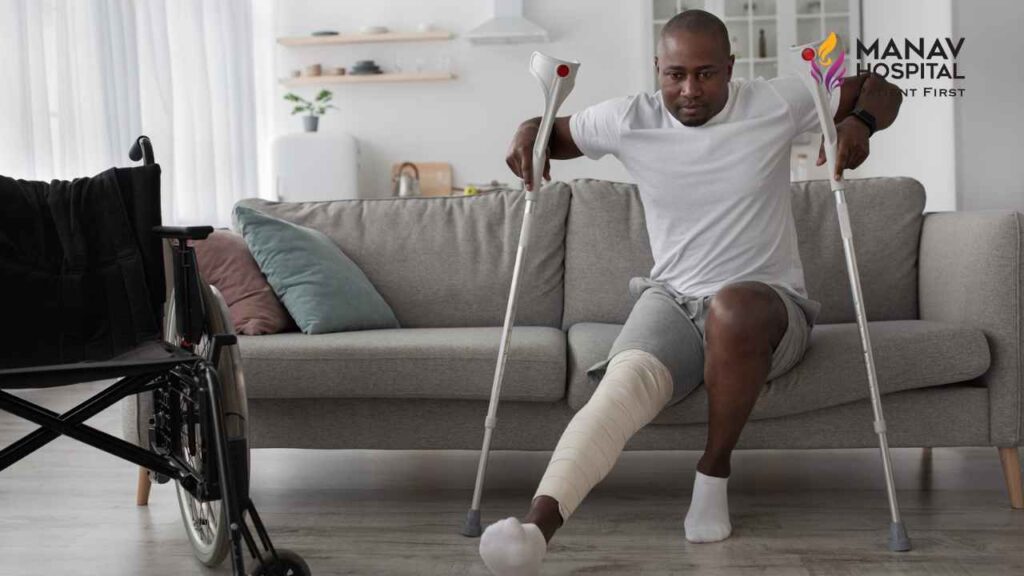
The first weeks focus on protecting the fixation, controlling swelling, caring for the wound and keeping nearby joints moving as allowed. You may be non-weight-bearing or partly weight-bearing. Your surgeon will set the rules, and they’re not suggestions.
Phase 2: Controlled Loading
As X-rays show callus forming, you progress to assisted movement and partial weight-bearing, if permitted. This is progress guided by images and symptoms, not fixed dates.
Phase 3: Strengthening
Muscle strength, balance and walking pattern are rebuilt. The physiotherapy department at Manav Hospital is headed by Dr. Akash Saxena (BPT, MPT).
Phase 4: Return to Work and Sport
Return depends on the bone, your job and your strength. A desk job and a delivery job won’t have the same timeline.
Possible Complications and Warning Signs
● Infection, which is more likely in open fractures
● Delayed union or nonunion, where the bone is slow or fails to heal
● Malunion, where it heals in a poor position
● Stiffness of nearby joints
● Blood clots
● Implant irritation, which may sometimes need removal after healing
● Post-traumatic arthritis, especially with joint fractures
● Compartment syndrome, an emergency with severe, increasing pain and a tight swollen limb
Call your surgeon soon if
● Pain worsens after the first few days instead of easing
● The wound is red, hot, leaking or smells bad
● You develop fever or chills
● Swelling suddenly increases
● Numbness or tingling gets worse
● Your calf becomes swollen and tender
Go to emergency care if
● You have chest pain or sudden breathlessness
● The limb turns pale, blue or cold
● Pain becomes severe and unrelenting
Questions to Ask Your Surgeon
● What exactly is broken, and how complex is it?
● Is surgery needed, and how urgent is it?
● Which fixation method do you suggest, and why?
● Will I need more than one operation?
● When can I put weight on it?
● What’s my realistic healing and return-to-work timeline?
● What are my risks, given my age, sugar levels and smoking status?
● What rehab will I need, and where will I do it?
If your injury is around a joint such as the knee or hip, you may also want to read our guides on when you need knee replacement and what happens on the day of hip replacement surgery, since arthritis can follow a joint fracture. For hospital readiness, see what a hospital should have before you trust it with surgery.
Why Choose Manav Hospital for Fracture Care?
Key advantages
● A complex fracture surgery service with a named surgeon who plans each case
● 3D CT planning listed, with ring, external, dynamic and internal fixation options described
● Modular operation theatres with HEPA filtration, C-arm imaging and ICU support listed in the hospital’s facilities
● Multidisciplinary support from orthopaedic trauma, microvascular surgery and plastic surgery, as described on the page
● TPA and cashless support for patients with mediclaim or health insurance, as listed on the site. Please confirm cover with the hospital
Explore the orthopaedic department, or book an appointment.
What Are the Benefits of Early Specialist Care?
✔ A clear plan, with the fracture pattern properly assessed
✔ Lower risk of delays that complicate healing
✔ Fixation matched to your bone and skin
✔ A rehab plan built into the treatment
✔ Fewer surprises about time off work
Staying Informed
Manav Hospital shares updates on Facebook, Instagram, YouTube and LinkedIn. Results vary, and no outcome is guaranteed.
Why Do Ghaziabad Patients Choose Manav Hospital?
● Orthopaedics, anaesthesia, radiology, ICU and physiotherapy under one roof
● A 24×7 emergency ambulance and helpline on +91-9718942666
● A convenient Kavi Nagar location near State Bank of India and the Post Office
● A surgeon whose profile lists complex fractures, arthroscopy and arthroplasty
● Online appointment booking through the website
Conclusion
A complex fracture is a long road, but it’s a mapped one. Get care early, understand why your surgeon has chosen a particular fixation, protect it while the bone heals and treat rehab as part of the treatment. Healing times are ranges, not promises, and your own timeline depends on the bone, the injury and your health. If you or a family member has had a serious break, Manav Hospital’s orthopaedic team can assess it.
Contact Manav Hospital
Address: 1, B Block, Kavi Nagar, Ghaziabad, Uttar Pradesh 201002
Phone and 24×7 emergency helpline: +91-9718942666
Email: info.manavhospital@gmail.com
Follow on: Facebook | Instagram | YouTube
Book your orthopaedic consultation at Manav Hospital here
FAQs
What is considered a complex fracture?
A break with multiple fragments, displacement, joint involvement, an open wound or significant soft tissue injury. A surgeon decides this from examination and scans.
How long does a complex fracture take to heal?
It varies by bone and injury. Many take weeks to several months to unite, and full functional recovery can take longer. Your surgeon will track it with follow-up X-rays.
Will I need plates and screws?
Often, but not always. Options include plates, screws, rods, external or ring fixation and bone grafting. The choice depends on your fracture and skin condition.
Can I walk after fracture surgery?
It depends on the bone and the fixation. Some people are non-weight-bearing at first and progress gradually. Follow your surgeon’s instructions closely.
Why might I need more than one surgery?
If swelling or wound contamination is severe, surgeons may stabilise first and do definitive fixation later. Delayed healing can also need further treatment.
What are the warning signs after fracture surgery?
Worsening pain, wound redness or discharge, fever, sudden swelling, a swollen calf or colour change in the limb. You can contact the hospital for guidance, and go to emergency care if symptoms are severe.